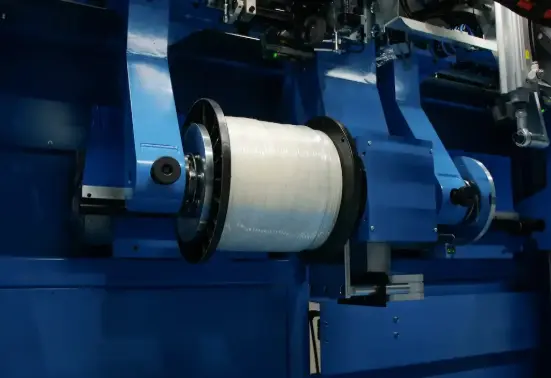
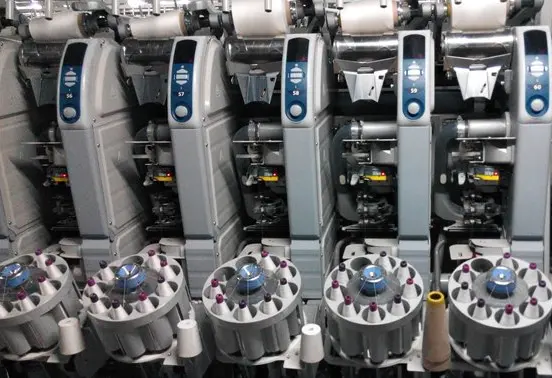
A battery winding machine is a piece of battery manufacturing equipment used to wind positive electrodes, negative electrodes, and separator films into a precisely controlled cell core. This wound core is often called a jelly roll because of its layered spiral structure.
The machine is widely used in lithium-ion battery production, especially for cylindrical cells and many prismatic-cell designs. Its role is not simply to roll materials together. It must maintain accurate alignment, stable tension, consistent winding geometry, and clean handling of delicate electrode materials. These factors directly affect cell consistency, safety, and later assembly efficiency.
How Does a Battery Winding Machine Work?
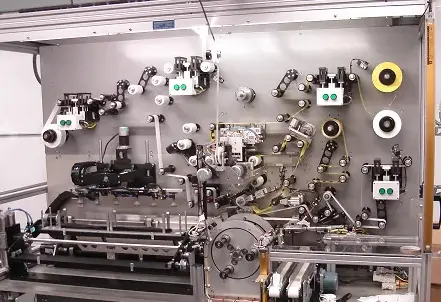
A battery winding machine feeds prepared electrode rolls and separator film through a controlled path. The materials are aligned, tensioned, and wound around a center pin or mandrel according to the required cell design.
A typical process includes the following steps:
- Material loading
Positive electrode, negative electrode, and separator rolls are loaded onto dedicated unwinding systems. - Web guiding and alignment
Guide rollers and alignment systems keep each material centered and positioned correctly before winding. - Tension control
The machine controls the tension of electrode foils and separator film to reduce wrinkles, stretching, damage, or unstable winding. - Electrode and separator winding
The materials are wound in a defined sequence around a cylindrical pin or flat mandrel. - Tab positioning or tab integration
Depending on the cell design and equipment configuration, electrode tabs may be positioned, welded, or prepared as part of the cell-core production process. - Tape fixing and core discharge
After the required winding dimensions are achieved, the finished cell core is secured with tape or another specified method and transferred to the next manufacturing stage.
Why Is Winding Important in Battery Manufacturing?
The wound cell core determines the internal arrangement of active battery materials. Poor winding quality can create misalignment, uneven pressure, damaged electrode edges, wrinkles, or inconsistent separator placement.
A well-configured battery winding machine helps manufacturers achieve:
- Better electrode alignment
- More consistent cell-core dimensions
- Stable material tension
- Reduced handling damage
- Higher production repeatability
- Improved automation compatibility
- More efficient downstream assembly
For battery manufacturers, winding accuracy is an important quality-control point because small deviations can affect subsequent cell assembly, sealing, electrolyte filling, formation, and testing processes.
Main Types of Battery Winding Machines
Battery winding equipment is commonly selected according to cell format, production scale, automation level, and process requirements.
Cylindrical Cell Winding Machines
Cylindrical cell winding machines create round jelly-roll cores. The electrode and separator materials are wound around a center pin to form a compact cylindrical structure.
These machines are commonly used for cylindrical lithium-ion battery cells used in power tools, consumer electronics, energy-storage products, and electric-mobility applications.
Prismatic Cell Winding Machines
Prismatic battery cells may use flat or elliptical winding designs. Instead of creating a round core, the machine winds the electrode materials around a specially shaped mandrel to produce a core suitable for a rectangular housing.
Prismatic winding requires close control of alignment and tension because the cell core must fit the intended housing dimensions without damaging the electrodes or separator.
Manual and Semi-Automatic Winding Machines
Manual and semi-automatic equipment is often used for battery research, pilot production, material development, and smaller-volume manufacturing.
These machines allow operators to adjust process settings and evaluate new cell structures before moving to high-volume production equipment.
Fully Automatic Battery Winding Machines
Fully automatic equipment is designed for larger-scale manufacturing. It can integrate material feeding, tension control, alignment, winding, tape application, inspection, and core discharge into one automated workflow.
The right level of automation depends on target capacity, cell design, production budget, quality requirements, and future expansion plans.
Key Components of a Battery Winding Machine
Although configurations vary, many battery winding machines include the following systems:
| Component | Main Function |
| Unwinding system | Holds and feeds electrode and separator rolls |
| Tension-control system | Maintains stable material tension during processing |
| Web-guiding system | Keeps electrodes and separators aligned |
| Winding mandrel or center pin | Forms the required cell-core shape |
| Servo-drive system | Controls movement, winding speed, and positioning |
| Cutting system | Cuts materials at the defined winding length |
| Tape application unit | Secures the completed jelly roll |
| Inspection system | Checks alignment, dimensions, and process abnormalities |
| PLC and HMI controls | Enable parameter settings, monitoring, and operation management |
The configuration should be based on actual electrode dimensions, separator width, cell format, tab design, production rhythm, and factory process flow.
Battery Winding Machine vs. Battery Stacking Machine
Winding and stacking are both used to assemble internal battery cell structures, but they follow different methods.
| Foliga | Battery Winding Machine | Battery Stacking Machine |
| Core structure | Spiral or wound jelly roll | Layered electrode stack |
| Common cell formats | Cylindrical and many prismatic cells | Often pouch and some prismatic cells |
| Material handling | Continuous roll-to-roll feeding | Individual sheet or Z-fold handling |
| Key quality focus | Tension, alignment, winding geometry | Layer positioning and stacking accuracy |
| Typical advantage | Efficient continuous processing | Flexible layered-cell design |
Neither method is universally better. The preferred solution depends on the battery-cell architecture, material characteristics, target capacity, energy-density objectives, and manufacturing strategy.
Key Quality Factors During Battery Winding
A battery winding machine should be evaluated not only by speed, but also by its ability to control quality-critical process conditions.
Electrode Alignment
Positive and negative electrodes must be positioned correctly relative to the separator. Misalignment can affect the designed active area and increase process risk.
Material Tension
Excessive tension may stretch or damage sensitive materials. Insufficient tension can lead to loose winding, wrinkles, or unstable core geometry.
Winding Speed
Higher speed can increase capacity, but it must remain compatible with material handling, alignment stability, and inspection capability. A faster machine is not automatically a better machine if quality control cannot keep pace.
Core Dimensions
The completed jelly roll must meet the required diameter, width, height, and shape tolerances for the downstream housing and assembly process.
Cleanliness and Damage Prevention
Electrode coatings and separator films can be sensitive to particles, scratches, burrs, folds, and edge damage. Equipment design should support clean material handling and stable transport.
How to Choose a Battery Winding Machine
Before purchasing a battery winding machine, manufacturers should clarify the following requirements.
1. Cell Format
Define whether the machine will produce cylindrical, prismatic, pouch-related wound cores, or multiple formats. The mandrel, material path, and automation configuration must match the intended cell design.
2. Electrode and Separator Specifications
Confirm electrode width, thickness, roll diameter, coating characteristics, separator type, and tab arrangement. These details determine the mechanical and control requirements of the machine.
3. Production Capacity
Specify the required output per shift, day, or year. Capacity planning should account for changeover time, inspection, maintenance, yield targets, and future expansion.
4. Automation and Integration
Consider whether the equipment must connect with upstream slitting, tab-welding, inspection, logistics, drying-room, or downstream cell-assembly systems.
5. Process Control and Data Traceability
For consistent production, the machine should support clear parameter control, alarm management, recipe storage, production records, and quality traceability appropriate to the factory’s needs.
6. Service and Technical Support
Equipment selection should include installation support, operator training, spare-parts availability, maintenance requirements, remote assistance capability, and long-term upgrade options.
FAQ
What does a battery winding machine produce?
A battery winding machine produces a wound electrode-and-separator core, commonly called a jelly roll. The core is then used in later battery-cell assembly stages.
Which battery cells use winding machines?
Winding machines are widely used for cylindrical cells and many prismatic-cell designs. Some pouch-cell processes use stacking or Z-folding instead, depending on the cell structure and manufacturing method.
What materials are wound in a battery winding machine?
The machine typically handles positive electrode material, negative electrode material, and separator film. The exact material structure depends on the battery chemistry and cell design.
Why is tension control important in battery winding?
Tension control helps keep electrode and separator materials stable during processing. Proper tension reduces the risk of wrinkling, shifting, stretching, and inconsistent cell-core geometry.
Can one battery winding machine make different cell sizes?
Some machines can support multiple sizes through tooling changes, programmable settings, or modular configuration. Compatibility must be confirmed against the required cell dimensions, material specifications, and production process.
Conclusion
A battery winding machine is a core piece of equipment in lithium-ion battery-cell manufacturing. It converts electrode and separator materials into a controlled wound cell core, supporting efficient production of cylindrical and many prismatic battery cells.
The right machine should be selected based on cell format, material dimensions, quality targets, automation needs, production capacity, and integration requirements—not only winding speed. Accurate alignment, stable tension, clean handling, and reliable process control are essential to producing consistent battery cell cores.
For battery winding machine consultation, production-line planning, or customized equipment requirements, contact DGDX Elec.