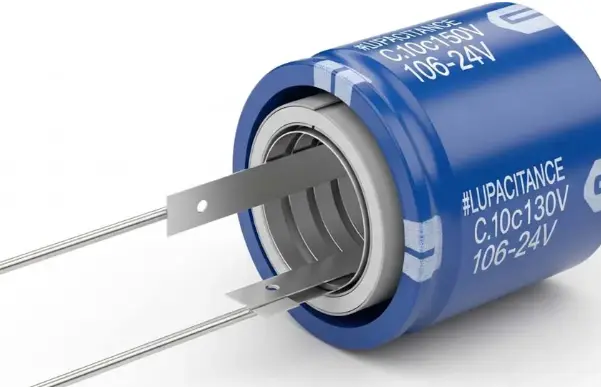
A capacitor is an electrical component that stores energy in an electric field. Although it is used in electronic circuits, its behavior can also be explained through a mechanical model. The most widely used mechanical representation of a capacitor is a spring because both components store energy and release it when system conditions change.
This engineering comparison is useful in mechatronics, vibration analysis, control-system design, electromechanical modeling, and technical education. It helps engineers understand how energy moves between electrical and mechanical systems.
What Is the Mechanical Representation of a Capacitor?
In a common force-voltage analogy, an electrical capacitor corresponds to a mechanical spring. The capacitor stores electrical energy, while the spring stores elastic potential energy.
When voltage is applied across a capacitor, electric charge accumulates on its plates. Similarly, when force is applied to a spring, the spring compresses or stretches. Both systems retain stored energy until the circuit or mechanical arrangement allows that energy to be released.
This similarity makes the spring a useful mechanical capacitor model for explaining energy storage and dynamic system behavior.
Capacitor and Spring: The Basic Analogy
The relationship between a capacitor and a spring can be understood through their energy-storage functions.
| Electrical System | Mechanical System |
| Capacitor | Spring |
| Voltage | Force |
| Electric charge | Displacement |
| Capacitance | Mechanical compliance |
| Electrical energy | Elastic potential energy |
A capacitor with higher capacitance can store more charge at a given voltage. In the mechanical model, a more compliant spring can produce greater displacement under a given force.
This is why mechanical compliance, rather than spring stiffness alone, is commonly associated with electrical capacitance. A stiff spring has low compliance, while a flexible spring has high compliance.
How a Mechanical Capacitor Stores Energy
The term mechanical capacitor is often used informally to describe a mechanical component or system that stores and releases energy in a way comparable to an electrical capacitor. In a simple spring model, energy is stored when the spring is compressed or extended.
The energy stored in an electrical capacitor is related to capacitance and voltage. The energy stored in a spring is related to spring stiffness and displacement. In both cases, the stored energy can later return to the system.
For example, a spring in a mechanical device may absorb energy during motion and release it afterward. In an electrical circuit, a capacitor may absorb charge during charging and discharge when the circuit requires energy.
Why the Mechanical Analogy Is Useful
The mechanical representation of a capacitor helps engineers compare systems that appear different but follow similar mathematical principles. This is especially valuable when designing integrated electrical and mechanical equipment.
Applications include:
- Electromechanical actuators
- Vibration-control systems
- Automotive suspension analysis
- Robotics and motion-control equipment
- Sensors and measurement devices
- Loudspeakers and acoustic systems
- Energy-harvesting equipment
- Control-system simulation
By using a mechanical capacitor model, engineers can visualize stored energy, damping, inertia, and oscillation more clearly.
Capacitor, Resistor, and Inductor in Mechanical Models
A complete electrical-mechanical analogy usually includes three fundamental components.
Capacitor and Spring
A capacitor stores electrical energy, while a spring stores mechanical energy. In the selected analogy, capacitance is related to mechanical compliance.
Resistor and Damper
An electrical resistor dissipates energy as heat. A mechanical damper dissipates motion energy, often through friction or fluid resistance. Both reduce the amount of usable energy in a system.
Inductor and Mass
An electrical inductor stores energy in a magnetic field. In a mechanical model, a mass stores kinetic energy while moving. Both components resist rapid changes in their respective flow variables.
Together, these relationships allow engineers to model electrical and mechanical systems using similar differential equations.
Important Note About Modeling Conventions
Engineers should use care when discussing a mechanical capacitor because different analogy conventions may map electrical and mechanical variables in different ways. In one common convention, the capacitor is represented by a spring. In another modeling approach, the correspondence can be expressed differently depending on how force, velocity, voltage, and current are assigned.
The key point is to select one analogy convention and apply it consistently throughout the analysis. Mixing conventions can create incorrect conclusions about stiffness, compliance, damping, or inertia.
For practical engineering communication, it is helpful to define the variables and equations at the beginning of a model.
From Theory to Electronic Component Selection
The mechanical representation of a capacitor is a valuable learning and design tool, but real capacitor selection must also consider electrical requirements. Important factors include capacitance value, rated voltage, dielectric type, tolerance, temperature range, equivalent series resistance, operating frequency, physical size, lifetime, and application environment.
For power supplies, motor-control equipment, consumer electronics, industrial automation, communication devices, and energy-storage circuits, the correct capacitor should be selected according to the complete circuit design.
Understanding the mechanical capacitor analogy can make capacitor behavior easier to visualize, while careful technical selection ensures the final electronic product performs reliably.
For capacitor sourcing, technical support, or customized electronic component inquiries, please contact DGDX Electronics.